Somewhere right now a SOC is proudly showing leadership a dashboard with “Credential Dumping: COVERED” in a reassuring shade of green. Click into it and you find the rule: process_name == "mimikatz.exe". Maybe, if the author was feeling ambitious, a second line for sekurlsa::logonpasswords on the command line. Congratulations. You haven’t built a detection. You’ve written a fan letter to Benjamin Delpy, and the only adversary it will ever catch is the one who forgot to rename a binary.
This is the oldest disease in detection engineering and it refuses to die: detecting the tool instead of the capability. The industry keeps confusing “the sample I saw in a report last Tuesday” with “the thing the attacker actually needs to accomplish.” Those are not the same object, and pretending they are is how you end up with a hundred rules and zero resilience.
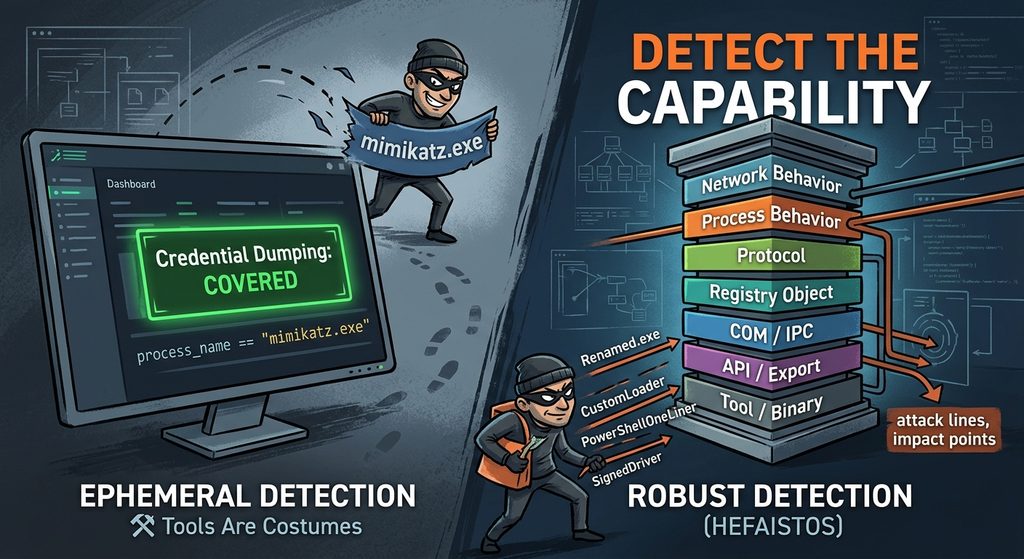
⚒️ Tools Are Costumes. Capabilities Are the Body.
We didn’t invent this idea, and we’re not going to pretend we did. Jared Atkinson and the SpecterOps crew have been hammering it for years: attacker tools are merely abstractions of attack capabilities. Mimikatz, a custom loader, a BOF, a PowerShell one-liner, a signed driver doing something it shouldn’t — different costumes, often the same underlying capability, frequently ending at the same function chains and the same operating-system objects.
Defenders, meanwhile, keep writing logic at the most superficial layer available, because it’s the layer that shows up in the threat report screenshot. That layer is also the easiest to evade. A rename. A recompile. A different tool that calls the same API. Your “coverage” evaporates and nobody notices because the green box on the dashboard doesn’t know it’s lying.
The fix isn’t “write more rules.” Writing ten tool-name rules instead of one just means you’ve collected ten fan letters. The fix is to know where your detection is anchored — and to choose that anchor on purpose.
🧱 Capability Abstraction in HEFAISTOS: What It Actually Is
This is why HEFAISTOS has a Capability Abstraction Library, and why it is a real backend model with real fields rather than a text box labelled “context.” Each entry captures the engineering ingredients you need to reason about resilience:
- Abstraction layer — where in the stack you’re reasoning
- Component artifact — the concrete mechanism you’re anchoring to
- Adversary purpose — why this capability exists in the attack chain at all
- Common evasions — how someone will walk around your anchor
- Expected observables — what evidence the capability should leave behind
- Applicable telemetry — where that evidence can actually be seen (not where you wish it could be seen)
- Detection value and robustness level — whether this anchor is worth engineering against
Plus ATT&CK technique linkage, versioning, review status, and a split between shared baseline entries and organization-scoped custom ones that your own engineers create and maintain.
The layers themselves are ordered strata: Network Behavior, Process Behavior, Protocol, Registry Object, COM / IPC, API / Export, Tool / Binary. They’re not metadata buckets. Each one is a question you should be able to answer about your own rule: are we detecting the tool? The export it calls? The IPC mechanism? The protocol? The behavior? If you can’t answer that, you don’t know what your rule detects. You know what it matched once.
📉 The Robustness Scale Is Not a Vibe Check
Every entry carries a robustness level from 1 to 5: Ephemeral, Weak, Moderate, Strong, Invariant. That number is not severity. It’s not confidence. It’s not “how much the analyst liked it.” It’s engineering value for resilient detections — how likely the anchor is to survive the adversary changing their implementation.
A filename match lives down at Ephemeral, and it should. It’s the detection equivalent of recognizing your neighbor by his hat. A capability-rooted anchor that every implementation is forced through climbs toward the top. When you can see those two numbers next to each other in a Workbench, it becomes very awkward to keep calling the hat rule “coverage.”
🔧 Where It Bites: The Workbench
A library nobody uses is just a glossary with a login page. So Capability Abstraction is wired into the place where detections actually get built:
- You select library entries onto a Workbench — they persist independently of library filtering, and switching techniques doesn’t silently wipe your selections.
- You pick a detection focus layer from what you selected. That’s you, in writing, committing to where the detection is anchored.
- The Capability Abstraction Map auto-renders your selections as ordered layer bands with coverage and robustness summaries — or flip it to manual mode, drag nodes around, edit edges, export a PNG for the people who only read pictures.
- The AI assistant treats selected abstractions as authoritative grounding: prioritize the focus layer, align blind spots, correlation ideas and test guidance to it, and judge rule quality against it in rule-improvement workflows.
- The focus layer, abstraction layer, component artifact, detection value and robustness get compiled into OpenTIDE metadata, so the reasoning travels with the detection instead of dying in somebody’s head.
Admins and Analysts can create and edit org-scoped entries; only Admins can delete eligible custom ones; the shared baseline stays read-only in ordinary use. Because “anyone can rewrite the capability model at 2 AM” is not a governance strategy.
🤦 Confession Corner: We Described Our Own Feature Badly
Time for the part where we eat our own cooking. For a while, our internal description of Capability Abstraction was some flavor of “it adds more context on top of ATT&CK.” That’s wrong, and it was wrong in a way that matters. “More context” is how you describe a notes field. Capability Abstraction is supposed to be precise, detailed, surgical — the structured middle layer between “this is technique T1003” and “here’s my KQL.” ATT&CK tells you what neighborhood you’re in. It does not tell you which layer your logic is welded to, which observables survive a tool swap, or which evasions you just invited.
Second confession: the exact semantic ordering of those seven layers still deserves another tightening pass. We know. It’s on the list. We’d rather tell you that than ship a beautifully confident diagram that quietly lies.
🚫 And No, You Don’t Need It for Everything
Here’s where the methodology cultists will be disappointed. Capability Abstraction is not mandatory for every detection. If your rule is “alert on traffic to this one IP,” or a specific hash, or a short-lived containment watch for a known-bad domain, there is no abstraction problem to solve. You already know exactly what you’re looking for. Building a seven-layer model around a single IOC is paperwork cosplaying as engineering.
And to kill the other misconception before it spawns: Capability Abstraction is not the detection, and it is not the rule. It’s the model you reason with. The detection is the analytic objective. The rule is one implementation of it in one query language. The AI doesn’t stop working when there’s no CA on the Workbench either — it grounds on the rest of the Workbench content. CA is high-value grounding when the problem actually has multiple implementation paths. It’s not a tax on every ticket.
🎯 So What Do You Do Monday Morning?
- Pull up your “covered” credential-access and injection detections. For each one, write down the layer it’s anchored to. Be honest. “Tool / Binary” is an allowed answer; it’s just an embarrassing one.
- For anything sitting at Ephemeral or Weak that you’re counting as coverage, ask what the capability needs that every implementation has to go through — and whether you even have telemetry at that layer.
- Keep the fan letters if you must. Atomic tool rules have their place as cheap tripwires. Just stop putting them in the coverage report next to the word “detected.”
Rename the binary and your detection dies? Then it was never detecting the attacker. It was detecting the filename. Write to the capability, not the costume.
Happy hunting.
Featured image generated using Artificial Intelligence (EU AI Act transparency notice).